

Oslo / New Delhi | The Citizen Mirror Special Report
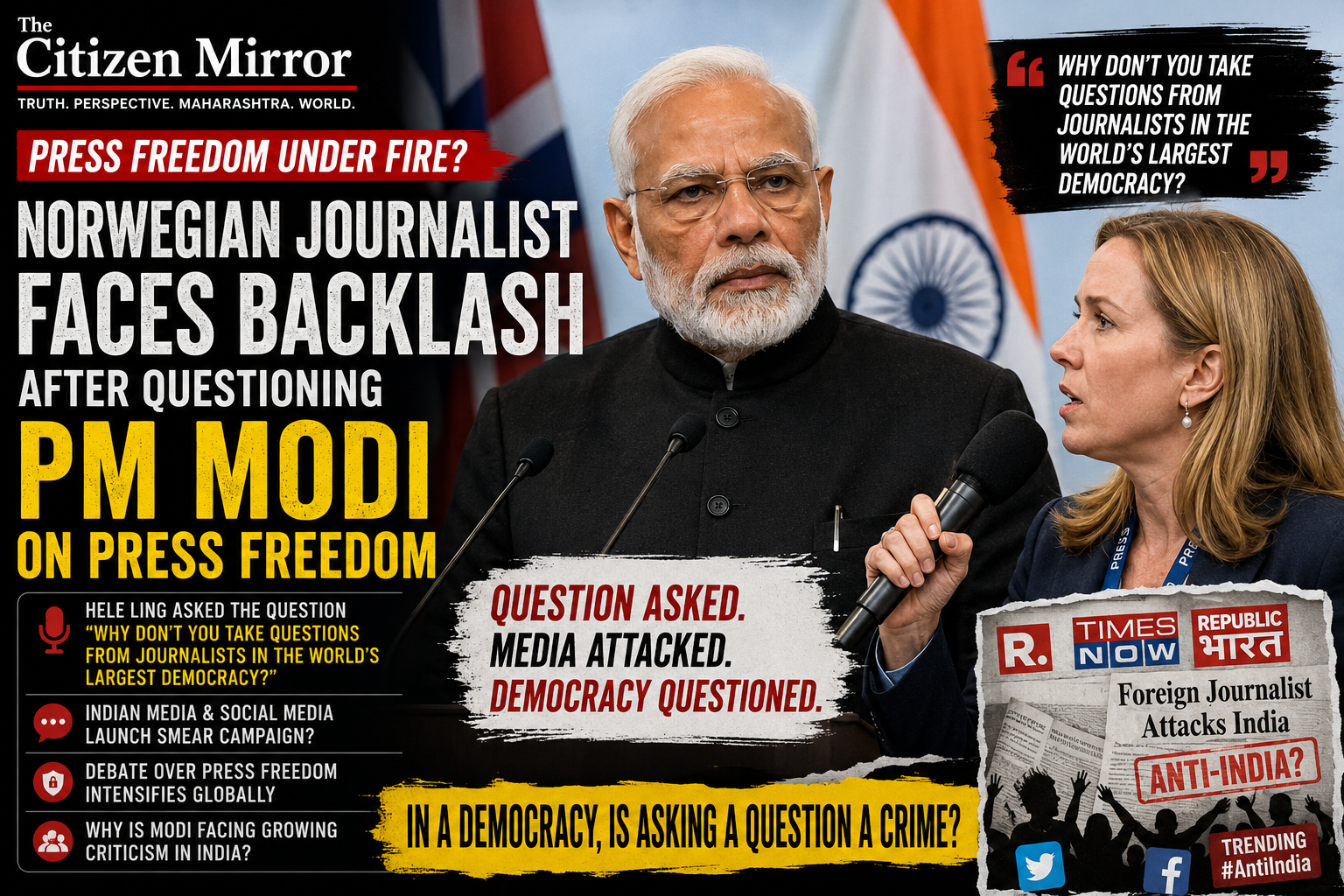
A political and media controversy has erupted after Norwegian journalist Hele Ling questioned Indian Prime Minister Narendra Modi about press freedom during a joint press interaction in Oslo. Following the viral exchange, the journalist reportedly faced heavy criticism online, reigniting international debate over media independence, democratic accountability, and the role of journalism in modern India.
The incident has once again brought global attention to the relationship between political power, mainstream media narratives, and freedom of expression in the world’s largest democracy.
The Question That Sparked The Debate
During the media interaction, Hele Ling asked Prime Minister Modi:
“Why do you not take direct questions from journalists in the world’s largest democracy?”
The moment quickly went viral across social media platforms and triggered intense reactions from political supporters, critics, journalists, and media commentators.
Soon after:
- online criticism intensified,
- social media campaigns emerged,
- debates over “media loyalty” resurfaced,
- and questions around press freedom gained international traction.
Growing Criticism Of Mainstream Media
Following the controversy, several independent journalists and political analysts questioned sections of India’s mainstream media ecosystem.
Critics argue that:
- aggressive questioning of political power has reduced,
- prime-time debates are increasingly polarized,
- media narratives often favor political establishments,
- and independent journalism faces growing pressure online.
At the same time, government supporters strongly reject these claims, arguing that:
- India has a vibrant and highly active media ecosystem,
- criticism against the government exists openly,
- and social media controversies should not be confused with censorship.
Why Criticism Against Modi Government Is Increasing
Over recent years, opposition parties, activists, and independent commentators have increasingly criticized the Modi government on issues including:
- unemployment,
- inflation,
- media freedom,
- institutional independence,
- digital surveillance concerns,
- social polarization,
- and the declining frequency of open press conferences.
Political observers say younger audiences and digital-first platforms are becoming more vocal in demanding transparency and direct accountability from political leaders.
Yet Modi Remains Politically Powerful
Despite criticism, Prime Minister Modi continues to maintain a strong political base due to:
- his leadership image,
- nationalist positioning,
- infrastructure development projects,
- welfare schemes,
- and India’s growing international visibility.
Analysts say India today reflects two parallel realities:
- a large and loyal support base for Modi,
- and a rapidly growing ecosystem of critics demanding greater democratic openness.
The Larger Democratic Question
Experts believe the controversy goes beyond one journalist or one question.
The real issue is:
- whether governments should face difficult questions openly,
- whether media institutions can remain independent,
- and whether public discourse is becoming increasingly polarized.
In democracies, journalism is expected not just to report events — but also to question power, challenge narratives, and represent public concerns.
The Citizen Mirror Analysis
The issue is not whether one agrees or disagrees with the journalist’s question.
The bigger concern is whether asking difficult questions is gradually becoming politically risky in highly polarized digital environments.
A healthy democracy depends on:
- independent journalism,
- transparent communication,
- public accountability,
- and the freedom to question those in power.
The role of media is not to blindly support or oppose governments — but to present facts, ask questions, and protect democratic dialogue.
Final Question
In a democracy, should journalists ask difficult questions or only applaud power?