

Mumbai | The Citizen Mirror Political & Infrastructure Desk
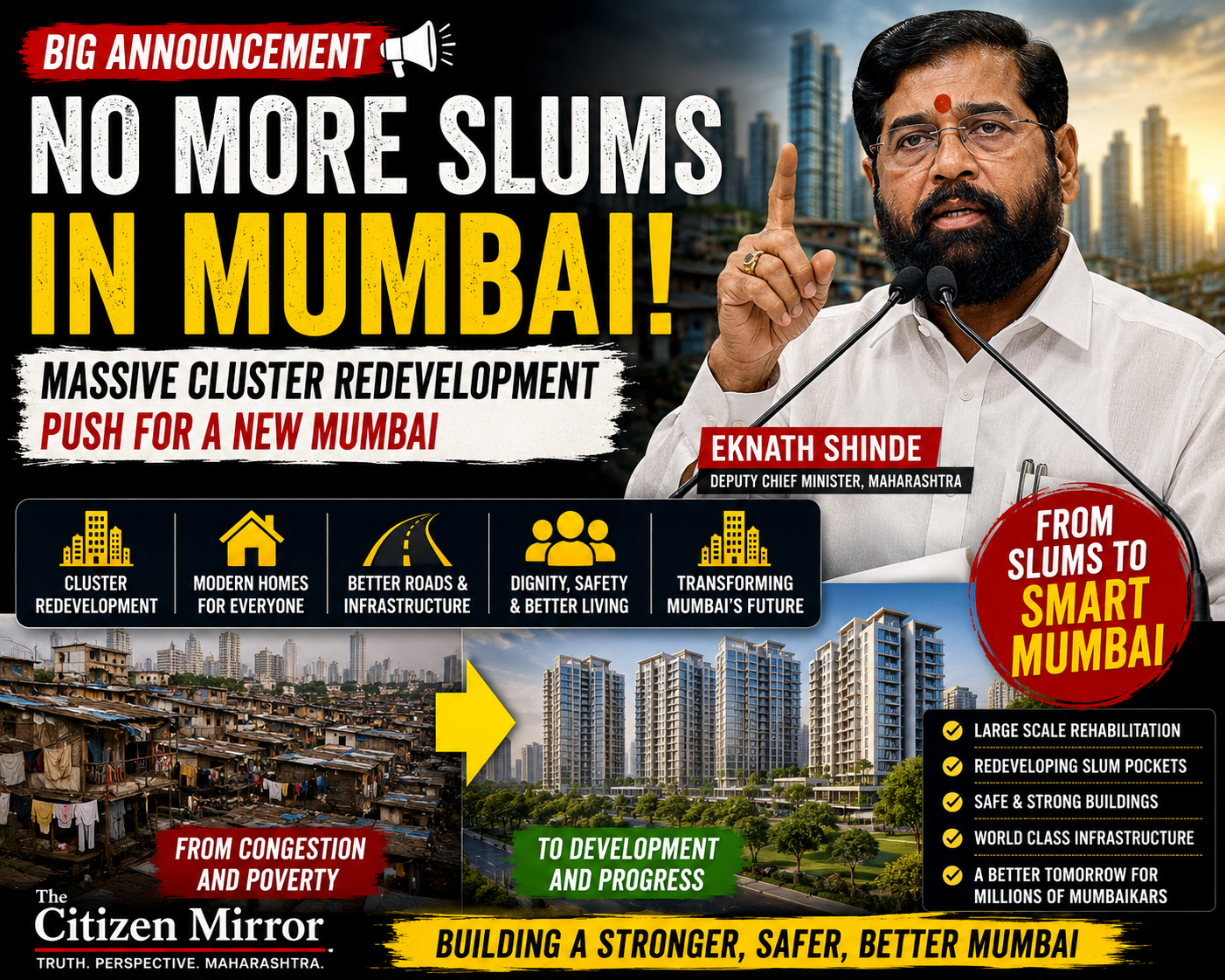
Maharashtra Deputy Chief Minister Eknath Shinde has announced an ambitious large-scale cluster redevelopment plan aimed at transforming Mumbai’s urban landscape, declaring that the city should eventually have “no more slums.” The statement has triggered major political, social, and real estate discussions across Maharashtra.
The announcement is being seen as one of the biggest urban redevelopment pushes in recent years, with the government focusing on large-scale rehabilitation, infrastructure modernization, and redevelopment of densely populated areas.
What Is The Government Planning?
According to the proposed vision, the government intends to accelerate:
- cluster redevelopment projects,
- slum rehabilitation,
- reconstruction of old and dangerous buildings,
- and modern housing infrastructure across Mumbai.
The redevelopment model is expected to include:
- slum pockets,
- dilapidated structures,
- overcrowded localities,
- and unplanned settlements.
“No More Slums In Mumbai”
The most discussed part of Eknath Shinde’s statement was his strong declaration:
“No more slums in Mumbai.”
Supporters have described the move as a bold development roadmap for India’s financial capital, while critics argue that implementation will be the real challenge.
Urban planning experts say the idea is ambitious but will require:
- massive financial planning,
- transparent rehabilitation systems,
- strong coordination,
- and long-term political commitment.
Mumbai’s Ground Reality
Mumbai continues to face serious urban challenges including:
- rapid population growth,
- expensive land prices,
- expanding slum settlements,
- delayed redevelopment projects,
- and incomplete SRA schemes.
Millions of residents still live in:
- unsafe structures,
- congested neighborhoods,
- and areas lacking proper civic infrastructure.
What Is Cluster Redevelopment?
Cluster Redevelopment refers to the redevelopment of multiple buildings or settlements together as a single urban project instead of rebuilding isolated structures individually.
The model generally includes:
- high-rise rehabilitation towers,
- wider roads,
- improved drainage systems,
- parking infrastructure,
- open spaces,
- and upgraded civic amenities.
Experts believe this approach can improve urban planning efficiency in highly congested cities like Mumbai.
Opportunity Or Displacement Concern?
While the redevelopment push could provide:
- safer housing,
- modern facilities,
- better infrastructure,
- and improved living standards,
concerns are also emerging regarding:
- delayed rehabilitation,
- displacement of original residents,
- builder-politics nexus,
- and transparency in project execution.
Housing rights activists argue that redevelopment should prioritize residents rather than purely commercial interests.
Major Boost For Real Estate Sector?
Industry observers believe that if implemented aggressively, the plan could trigger major activity in:
- real estate,
- construction,
- infrastructure investment,
- and urban redevelopment markets.
Areas such as:
- Dharavi,
- Kurla,
- Bhandup,
- Vikhroli,
- Thane,
- and Mumbai suburbs
could become key redevelopment zones in the coming years.
The Citizen Mirror Analysis
Mumbai’s slum redevelopment debate is not just about construction — it is deeply connected to:
- social justice,
- housing rights,
- urban economics,
- and political power.
While the slogan “No More Slums” is politically powerful, the real success of the plan will depend on:
- transparent execution,
- fair rehabilitation,
- public trust,
- and sustainable urban planning.
For Mumbai, the biggest challenge remains balancing development with dignity for the people who built the city’s workforce and economy.