

New Delhi | The Citizen Mirror Political Desk
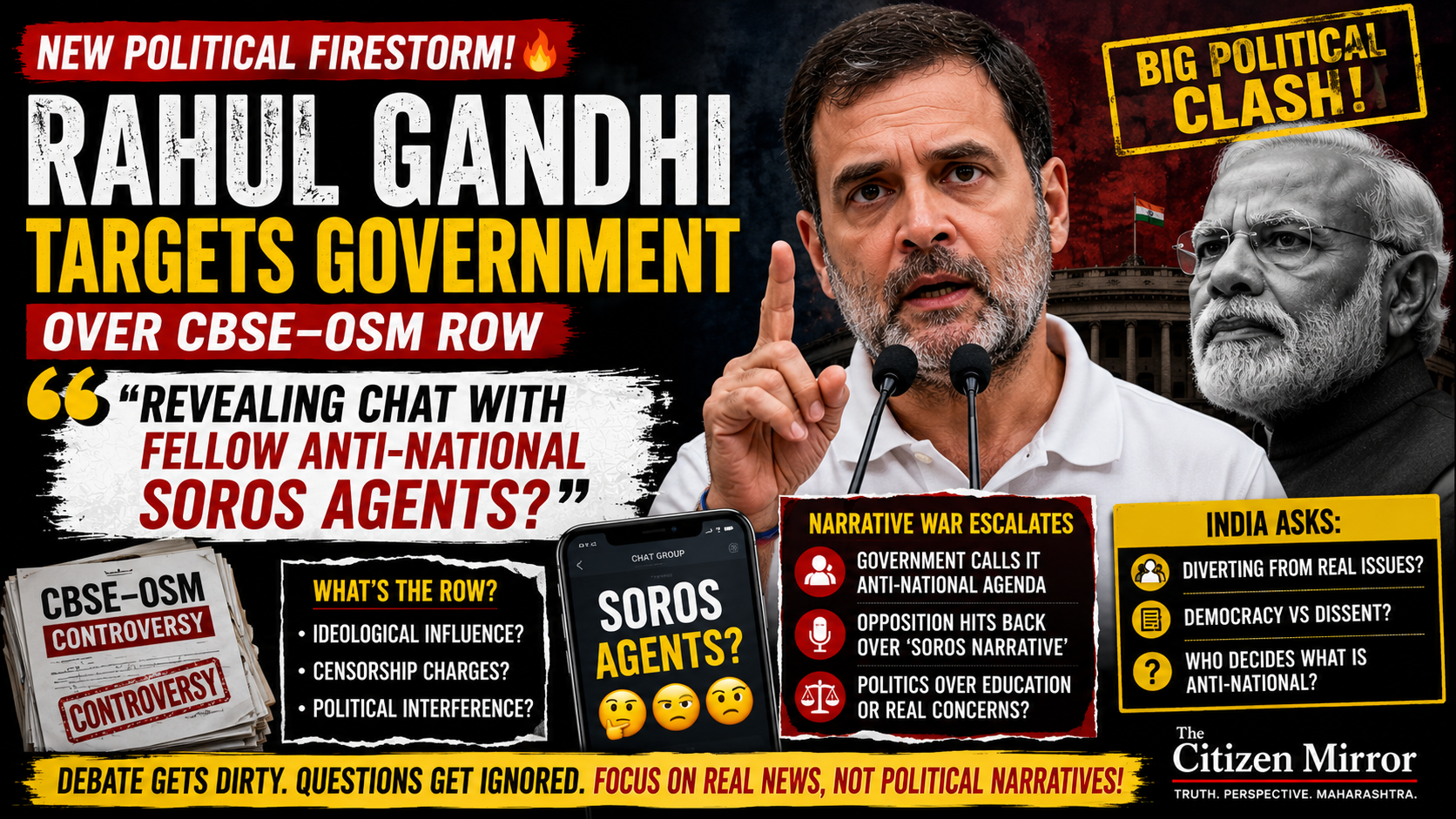
A fresh political confrontation has erupted after Congress leader Rahul Gandhi took a sharp dig at the Central Government over the ongoing CBSE–OSM controversy, sarcastically referring to “fellow anti-national Soros agents” during his remarks. The statement has intensified the already heated political battle between the opposition and the BJP-led government over allegations of ideological influence, censorship, and political targeting.
The controversy quickly exploded across social media and political circles, triggering reactions from both ruling party leaders and opposition supporters.
What Did Rahul Gandhi Say?
Taking aim at the government’s repeated attacks linking critics to billionaire investor George Soros, Rahul Gandhi sarcastically remarked about “revealing chats with fellow anti-national Soros agents.”
The comment was widely interpreted as a direct attack on the government’s narrative that foreign influence and anti-national networks are attempting to interfere in Indian institutions and politics.
The statement came amid the ongoing debate surrounding the CBSE–OSM issue, which has become a major political flashpoint.
Why The Soros Narrative Is Politically Sensitive
Over recent years, sections of the ruling establishment and its supporters have repeatedly accused:
- opposition leaders,
- activists,
- NGOs,
- journalists,
- and international networks
of working against India’s interests with alleged foreign backing.
George Soros, in particular, has become a symbolic political reference in Indian political debates after his criticism of Prime Minister Narendra Modi and concerns over democratic institutions in India.
Opposition leaders, however, claim the “Soros narrative” is increasingly being used to:
- discredit critics,
- divert attention from real issues,
- and label dissent as anti-national.
CBSE–OSM Row Escalates Political Tensions
The controversy surrounding the CBSE–OSM issue has now moved beyond education policy and entered mainstream political warfare.
Political observers say the debate reflects a much larger ideological battle over:
- control of narratives,
- influence over institutions,
- nationalism,
- and freedom of criticism in India.
BJP vs Congress: Narrative Battle Intensifies
The BJP has consistently positioned itself as defending national interests against what it describes as “anti-India ecosystems.”
Meanwhile, Congress and opposition leaders argue that:
- criticism is being branded anti-national,
- democratic dissent is under attack,
- and public discourse is becoming increasingly polarized.
Rahul Gandhi’s latest remark is being viewed as an attempt to mock and challenge that narrative directly.
Social Media Reacts
Soon after the statement surfaced:
- political hashtags began trending,
- supporters praised Rahul Gandhi’s sarcasm,
- critics accused him of trivializing national concerns,
- and political debates intensified across television and digital platforms.
The issue has once again exposed the deep political polarization dominating India’s media and social media environment.
The Citizen Mirror Analysis
The latest exchange highlights how political communication in India is increasingly shifting from policy debates toward narrative wars, symbolism, and ideological branding.
Terms like:
- “anti-national,”
- “toolkit,”
- “ecosystem,”
- and “Soros agent”
have now become major weapons in political messaging from both sides.
Analysts believe this reflects a larger transformation in Indian politics where perception management and digital narratives increasingly influence public opinion.
Final Question
Is India witnessing a battle of ideologies or a battle to control public perception?